

Baltic Energy Ministers agree to establish joint contingency reserves for the protection of critical energy infrastructure
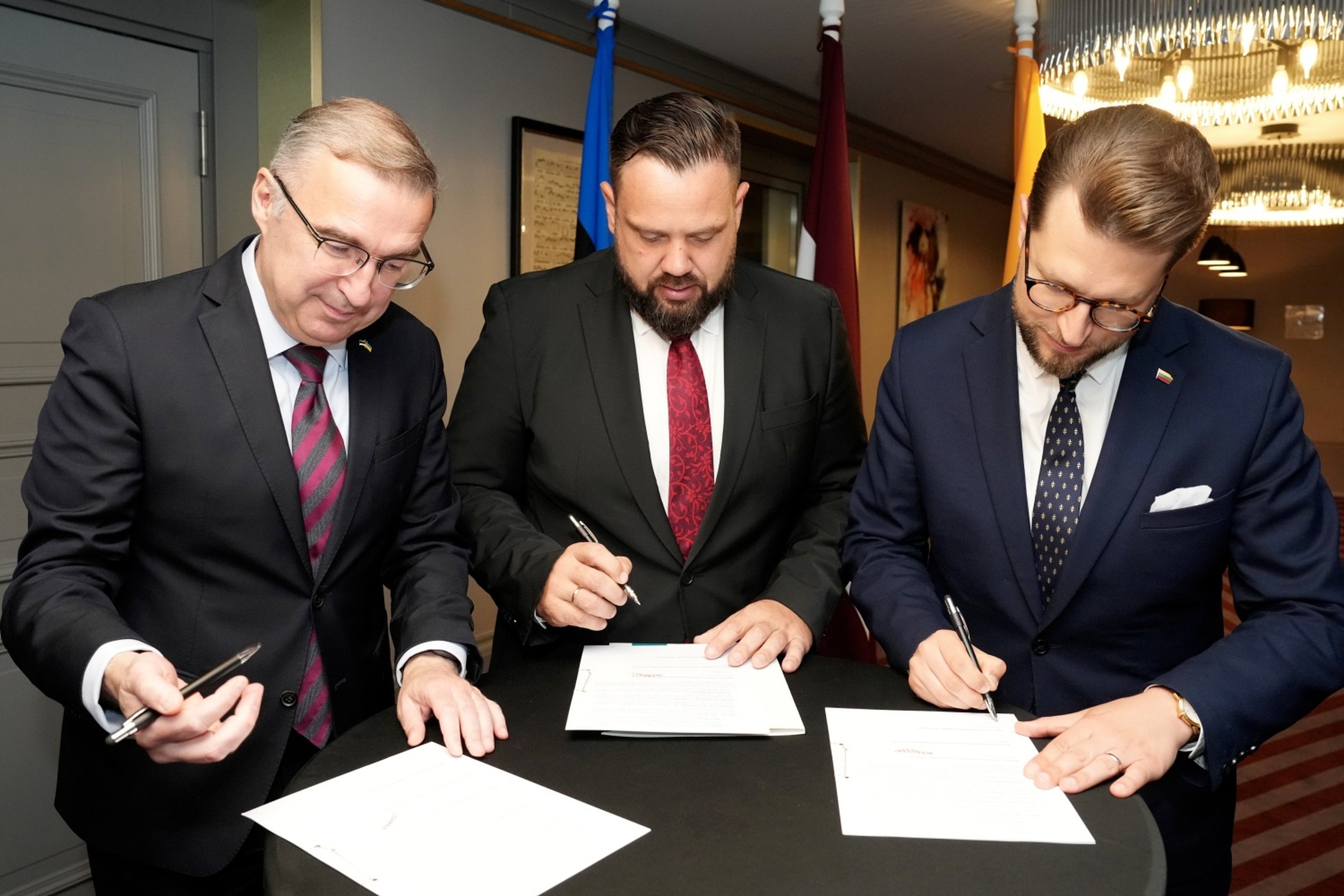
Lukas Savickas, Jānis Vitenbergs and Andres Sutt. Photo by Ieva Leiniša (LETA)
Considering the heightened geopolitical tensions in the region, the Energy Ministers of the Baltic States agreed on Wednesday, 22 July, to strengthen the region's collective energy security by establishing joint energy system contingency reserves. This will enable faster restoration of electricity supply to households and businesses in the event of various threats or damage to critical infrastructure.
The ministers stressed that the Baltic States have demonstrated their ability to phase out Russian energy resources and successfully synchronise with the Continental European electricity system. At the same time, the Baltic region is facing new security challenges that require a united approach and closer cooperation in strengthening critical infrastructure and ensuring a faster restoration of electricity supply in the event of disruptions to the energy system.
During the meeting, Latvia's Minister for Climate and Energy, Jānis Vitenbergs, Estonia's Minister of Energy and Environment, Andres Sutt, and Lithuania's Minister of Energy, Lukas Savickas, signed a joint declaration on the establishment of Baltic energy system contingency reserves.
"Following the synchronisation of the Baltic States with the European electricity system, our responsibility for energy security has become even greater. The security of our region is only as strong as its weakest link. Today we are taking a practical step to turn political commitment into concrete action. The establishment of Baltic energy system contingency reserves will be a unique example of regional cooperation and a new model for energy security in Europe that can serve as an example for other countries," said Minister for Climate and Energy Jānis Vitenbergs.
Under the declaration, the Baltic transmission system operators will jointly assess the contingency equipment needed to ensure the fastest possible restoration of electricity supply across the Baltic States in the event of various threats or damage. Such contingency equipment may include transformers, transmission towers, generators and other reserve assets.
Based on this joint assessment, the transmission system operators will be able to prepare a joint application for European Union funding, including through the Connecting Europe Facility (CEF), to procure and maintain contingency reserves at the Baltic regional level. CEF funding will significantly reduce the investment burden on electricity consumers.
During the meeting, the ministers also discussed cooperation and coordination among the Baltic distribution system operators in emergency situations. They welcomed the recently concluded mutual assistance agreement between the Latvian and Lithuanian distribution system operators, which complements the existing cooperation memorandum between Latvia and Estonia. Building on these arrangements, the Baltic distribution system operators will continue developing a practical mutual assistance model to ensure a faster restoration of electricity supply, for example following storm-related damage.
The Ministers also discussed hybrid threats facing the Baltic region and possible measures to strengthen the protection of critical energy infrastructure. The Baltic Ministers underlined: "The risks posed by unmanned aerial vehicles have become a new security reality. Therefore, the accelerated deployment of counter-drone solutions is no longer an additional security measure – it has become an integral part of critical infrastructure protection at the regional level."
In the context of hybrid threats, the Latvian Minister for Climate and Energy, Jānis Vitenbergs, presented Latvia's approach to strengthening the protection of critical energy infrastructure against threats posed by unmanned aerial vehicles (UAVs). Latvia is currently developing a coordinated approach to the deployment of counter-drone solutions across the critical energy infrastructure. This approach envisages common technical requirements, interoperability of technologies, a coordinated procurement approach, and closer cooperation between critical infrastructure operators and public authorities. Its objective is to ensure a common situational awareness and more effective coordination between energy infrastructure operators and national security authorities.
Considering Estonia's initiative in the EU Energy Council to accelerate the phase-out of Russian energy resources, which was also supported by Latvia and Lithuania, the ministers stressed that the European Union must continue pursuing a consistent policy of gradually eliminating its dependence on Russian energy resources.
Immediately after Russia's full-scale invasion of Ukraine in 2022, the Baltic States ceased the physical import of Russian natural gas, well before the European Union adopted legislation on the gradual phase-out of Russian gas imports. The experience of the Baltic States demonstrates that a similar approach is also feasible regarding Russian oil imports into the European Union.
Last updated: 05-08-2026
Related news:
Nordic-Baltic energy ministers focus on support for Ukraine, energy security and the energy market