

Energy Council: agreement reached on the revision of the EU electricity market design, assistance to Ukraine and preparation for the winter season discussed
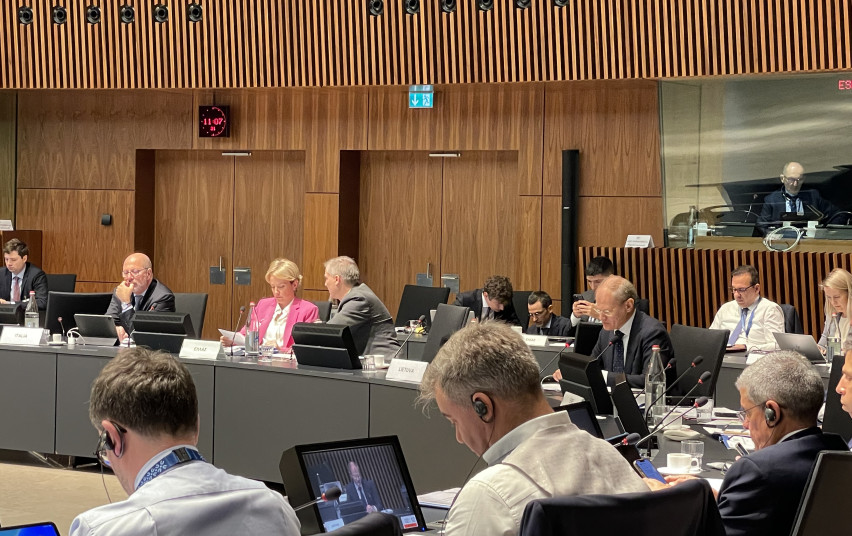
On 17 October, Vice-Minister of Energy Albinas Zananavičius attended the meeting of the European Union (EU) Transport, Telecommunications and Energy Council (Energy) in Luxembourg, which focused on an agreement among the EU Member States regarding a proposal to revise the rules for the EU electricity market design, discussed energy cooperation between Ukraine and the EU, and presented information on preparation for the upcoming winter season as well as other relevant issues.
The most important agenda item at the meeting of the Energy Council was reaching a consensus among the Member States – the common approach of the Council of the EU – on the Electricity Market Design Regulation. In response to the energy crisis, which has seen natural gas prices reach unprecedented highs since the outbreak of war in Ukraine, the European Commission has submitted proposals for the revision of the EU single electricity market. The proposals aim to reform the EU electricity market design to accelerate the development of renewables, to protect consumers from future price spikes, and to make EU industry cleaner and more competitive. A common approach on the Regulation was already sought at the Energy Council meeting in June, but further discussions were needed to reach agreement among all Member States.
“We have supported the revision of the EU electricity market design from the very beginning, as it is crucial in these unstable times that we can provide as much clarity as possible to energy market participants. During the negotiations, Lithuania achieved the inclusion of flexibilities for the Baltic States in the text of the Regulation, which temporarily postpone the application of the provisions on the electricity balancing market mechanism. This is very important in view of the specific situation regarding the synchronisation of the Baltic States with the Continental European grids, and we are therefore pleased with the outcome of the negotiations,” said the Vice-Minister.
The legislation, which will also bring positive changes for consumers and boost the development of renewables, is expected to be adopted before the end of this year following negotiations with the European Parliament.
The Energy Council meeting was also attended remotely by German Galushchenko, Vice-Minister of Energy of Ukraine, who introduced the situation of the energy sector in Ukraine. According to Ukrainian intelligence, Russia is planning major new attacks aimed at destroying energy infrastructure, which may lead to the need of Ukraine to import additional electricity from Europe. Assistance to the Ukrainian energy sector remains crucial in view of Russia’s targeted attacks on Ukraine’s energy infrastructure. Mr Galushchenko also thanked the EU for its support in electing a Ukrainian representative to the IAEA Board of Governors.
“Lithuania has provided and will continue to provide assistance to the Ukrainian energy sector. Lithuania’s most significant support to Ukraine so far has been two powerful autotransformers, each of which will provide electricity to hundreds of thousands of Ukrainians. It is important that all EU Member States remain united and determined to help Ukraine – only our solidarity will help achieve victory,” said Mr Zananavičius.
At the Council meeting, the European Commission presented the situation in preparation for the upcoming winter. Measures have been taken at EU level, such as the obligation to fill up gas storage facilities in the EU in order to ensure that citizens will not run out of heat or light in their homes during winter. The security of Lithuania is ensured by the natural gas terminal in Klaipėda, the reserves accumulated in Latvian gas storage facilities, and the strategic energy interconnections. Lithuania was the first EU country to completely refuse energy imports from Russia, but despite the share of imports still remaining, the entire EU has managed to reduce its dependence on Russia significantly.
The Estonian and Finnish delegations presented the situation regarding the incident of the Balticconnector gas leakage. An investigation is currently underway to determine its cause. Despite the incident, gas supply to both Finland and Estonia remains stable and the necessary gas supply volumes will be ensured during winter.